




By Dr. Ben Wright, DO — Aging Backwards Wellness, Manti, Utah
Fish oil is the supplement everyone with multiple sclerosis has been told to take and almost nobody has been told why. People in our community ask us: "Is it doing anything? How much? Does it matter which kind?" Those are good questions, and the research answers them better than the shelf does.
Tami's reasons were the slow thoughts and the low days that rode along with them. After her diagnosis, the same year she was told to plan on a cane, fish oil was one of the first things in her routine, and it is still there every tennis season.
Why omega-3s matter when you have multiple sclerosis
Your brain is one of the fattiest organs you own, and it is particular about which fats. DHA, one of the two main omega-3s in fish, is built directly into nerve-cell membranes, where it helps regulate how nerves signal, how cells survive stress, and how much inflammation the brain tolerates [1]. "Supports nerve-cell membranes" is not a slogan; it is what DHA literally does.
EPA, the other omega-3, is raw material for resolvins and protectins, the molecules your body makes to switch inflammation off [2]. In the mouse model of multiple sclerosis, dietary DHA calmed the immune cells that drive the attack [3].
Mood matters here too: roughly one in four people with multiple sclerosis has depression [4]. Across 26 general-population trials, omega-3s improved depressive symptoms, with EPA-rich formulas at up to 1 gram of EPA a day doing the work [5].
What the research shows
Start with the biggest picture: eating fish at least weekly went with 44% lower odds of developing multiple sclerosis in a California study [12], and six pooled studies found about 23% lower risk [13]. Omega-3s and multiple sclerosis have been linked for a long time.
In people who already have multiple sclerosis, the signal shows up where you'd feel it. In the HOLISM survey of 1,368 people with relapsing multiple sclerosis, those eating fish three or more times a week or taking omega-3s scored better in every quality-of-life domain [9]. In 50 people on interferon, 4 g of fish oil daily for a year lowered the inflammatory signals TNF-α, IL-1β and IL-6 [7]. In a one-year pilot of 31 people on DMTs, a very-low-fat diet plus 3.3 g of EPA+DHA improved physical quality of life and mental health at six months [8]. A 2021 review of seven multiple sclerosis studies drew the same conclusion: better inflammatory markers and quality of life [10].
Omega-3s sit alongside whatever route you've chosen for the disease itself — one thing the studies also show is that fish oil doesn't do what a disease-modifying drug does [6] — and the trials that paired them with DMTs found no interference and no harm [6–8]. For mood, the multiple sclerosis-specific data so far is a small three-month pilot that didn't separate from placebo [11]; red-cell membranes take about that long just to change, so the longer general-population trials above are the better guide, and we'll say so when a longer multiple sclerosis study arrives.
Why we're comfortable with this formula
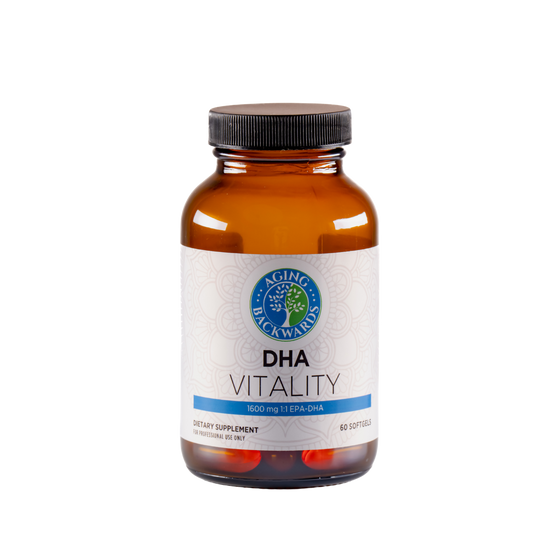
Two softgels of DHA Vitality™ deliver 1,600 mg of omega-3s as 800 mg EPA and 800 mg DHA. That is the everyday dose, one your doctor can build on; the multiple sclerosis trials used 2–4 g, and the trial-range option is in the table below. It sits squarely in the EPA range that worked for mood [5], and the equal DHA is deliberate: it is the fat your nerve membranes are built from [1].
We supply the oil in the triglyceride form, the way it exists in fish; head-to-head, triglyceride oils raise blood omega-3 levels about a quarter more than the cheaper ethyl-ester form [14,15]. Tocotrienols and tocopherols keep the oil from oxidizing in the bottle.
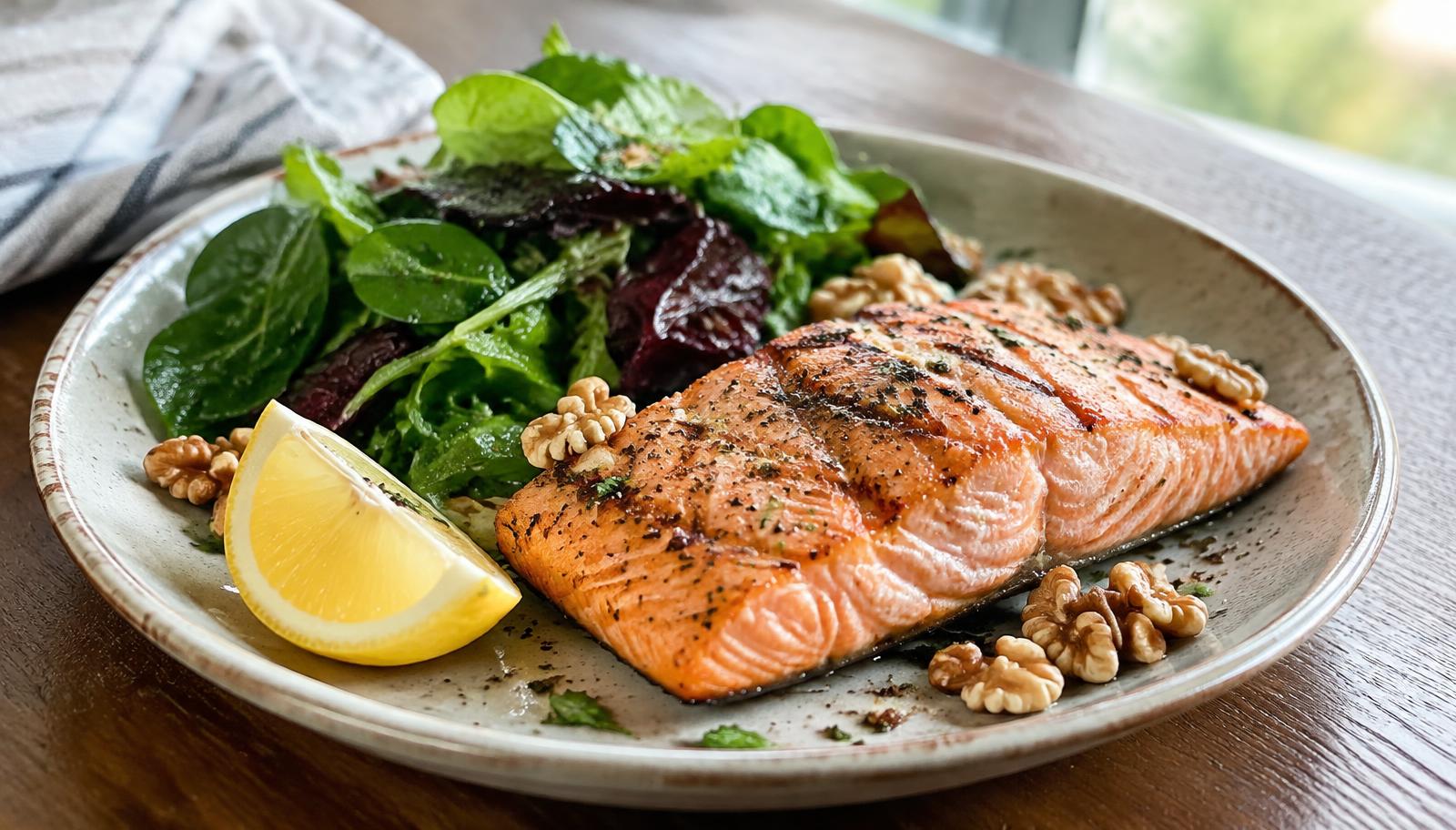
Then take it with fat. Absorption climbs sharply with a fat-containing meal [16]: eggs and avocado at breakfast, or salmon at dinner. Red-cell membranes take about three months to reflect a new dose [17]; give it twelve weeks.
At a glance: how much to take
The label is your starting point, not your ceiling. The trials behind this product often used more, and the rows below show where the research went. Anything above the label is a conversation to have with your own physician — bring the numbers with you.
| Situation | How much | Notes |
|---|---|---|
| Start here (label) | 2 softgels with your fattiest meal | Plus fish 2–3 times a week; give it 12 weeks |
| Low-mood or high-inflammation stretch | 4 softgels a day (3.2 g, the multiple sclerosis-trial range), split between two fatty meals | Ask your neurologist first; stay under 5 g EPA+DHA total |
| Ask first | — | Blood thinners or antiplatelets, atrial fibrillation history, surgery coming; skip with true fish allergy |
| Multiple sclerosis relapse or new symptoms | Don't change any dose on your own | Call your neurologist first |
If this is you
Brain fog, word-finding trouble, a low mood that lingers. Take 2 softgels with your fattiest meal, daily, for 12 weeks minimum. Eat fish two or three times a week on top (sardines, salmon, anchovies); the people who did best in HOLISM ate fish, not just capsules [9]. If mood is the main issue, tell your doctor.
You want the trial-range dose. The multiple sclerosis studies used 2–4 g a day [6–8]. Ask your neurologist first, keep total EPA+DHA under the FDA's 5 g ceiling [18], and let an omega-3 index blood test show whether you need more. The target is 8–11% — the range tied to the lowest heart risk and the best brain-function data; most Americans sit at 4–5% [21].
You take a blood thinner or antiplatelet, have a history of atrial fibrillation, or have surgery coming. Ask your doctor or pharmacist first. For context: at 3–6 g most studies found no meaningful INR change [18], and a cardiac-surgery trial tied higher omega-3 levels to less bleeding [19]. The atrial fibrillation signal came from heart trials at 4 g a day [20]; two softgels is less than half that.
Whichever route you've chosen for the disease itself. Some in our community take a disease-modifying therapy; some, with their doctors, have chosen not to. The dose is the same either way. On a DMT, the multiple sclerosis trials ran alongside interferon and glatiramer without a signal. Off a DMT, omega-3s are doing more of the inflammation-resolving work on their own — so the daily softgels, the fish on the plate, and a full season before you judge it all matter more.
A short safety word: no interaction with any disease-modifying therapy is documented, and the multiple sclerosis trials ran on interferon and glatiramer without a signal [6–8], but tell your neurologist anyway. Skip it with a true fish allergy. In pregnancy DHA is actively recommended; confirm the dose with your obstetric provider [18].
Where Tami landed
"The fog didn't lift in a week — it lifted in a season. One day I realized I'd gotten through a whole tennis match calling the score without reaching for a single word. That's when I stopped thinking of fish oil as optional."
That's where I land too. Omega-3s are foundational: they are what your nerve membranes are made of, they feed the body's own off-switch for inflammation, and the people who eat and take them report better days. Build the foundation; it holds up whatever plan you and your neurologist have chosen for the disease itself.
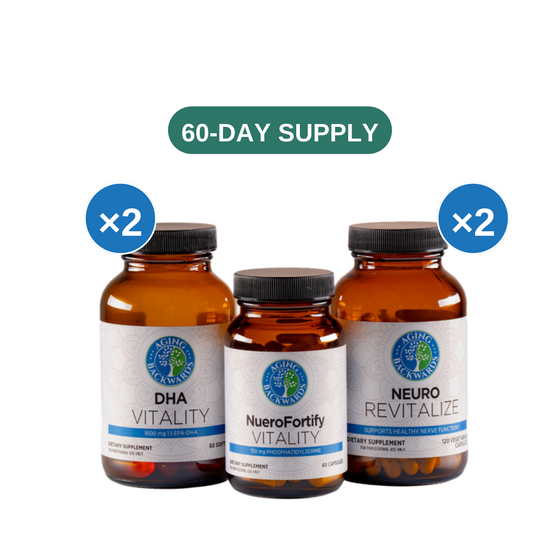
DHA Vitality™ anchors the Neuro Vitality Package™ at agingbackwardswellness.com. If you've been told to take fish oil, this is the one worth taking — with fat, at a real dose, for a full season.
References
- Bazinet RP, Layé S. Polyunsaturated fatty acids and their metabolites in brain function and disease. Nat Rev Neurosci. 2014;15(12):771–785. https://doi.org/10.1038/nrn3820
- Serhan CN. Pro-resolving lipid mediators are leads for resolution physiology. Nature. 2014;510(7503):92–101. https://doi.org/10.1038/nature13479
- Feng C, Li L, Li Q, et al. Docosahexaenoic acid ameliorates autoimmune inflammation by activating GPR120 signaling pathway in dendritic cells. Int Immunopharmacol. 2021;97:107698. PMID 33932699. https://doi.org/10.1016/j.intimp.2021.107698
- Marrie RA, Reingold S, Cohen J, et al. The incidence and prevalence of psychiatric disorders in multiple sclerosis: a systematic review. Mult Scler. 2015;21(3):305–317.
- Liao Y, Xie B, Zhang H, et al. Efficacy of omega-3 PUFAs in depression: a meta-analysis. Transl Psychiatry. 2019;9(1):190. PMID 31383846. https://doi.org/10.1038/s41398-019-0515-5
- Torkildsen Ø, Wergeland S, Bakke S, et al. ω-3 fatty acid treatment in multiple sclerosis (OFAMS Study): a randomized, double-blind, placebo-controlled trial. Arch Neurol. 2012. https://doi.org/10.1001/archneurol.2012.283
- Ramirez-Ramirez V, Macias-Islas MA, Ortiz GG, et al. Efficacy of fish oil on serum of TNFα, IL-1β, and IL-6 oxidative stress markers in multiple sclerosis treated with interferon beta-1b. Oxid Med Cell Longev. 2013;2013:709493. PMCID PMC3703725.
- Weinstock-Guttman B, Baier M, Park Y, et al. Low fat dietary intervention with omega-3 fatty acid supplementation in multiple sclerosis patients. Prostaglandins Leukot Essent Fatty Acids. 2005;73(5):397–404.
- Jelinek GA, Hadgkiss EJ, Weiland TJ, Pereira N, Marck CH, van der Meer DM. Association of fish consumption and omega 3 supplementation with quality of life, disability and disease activity in an international cohort of people with multiple sclerosis. Int J Neurosci. 2013. https://doi.org/10.3109/00207454.2013.803104
- AlAmmar WA, Albeesh FH, Ibrahim LM, et al. Effect of omega-3 fatty acids and fish oil supplementation on multiple sclerosis: a systematic review. Nutr Neurosci. 2021. PMID 31462182. https://pubmed.ncbi.nlm.nih.gov/31462182/
- Shinto L, Marracci G, Mohr DC, et al. Omega-3 fatty acids for depression in multiple sclerosis: a randomized pilot study. PLoS One. 2016;11(1):e0147195. PMID 26799942. https://doi.org/10.1371/journal.pone.0147195
- Langer-Gould A, Black LJ, Waubant E, et al. Seafood, fatty acid biosynthesis genes, and multiple sclerosis susceptibility. Mult Scler. 2020;26(12):1476–1485. https://doi.org/10.1177/1352458519872652
- Rezaeizadeh H, Mohammadpour Z, Bitarafan S, et al. Dietary fish intake and the risk of multiple sclerosis: a systematic review and meta-analysis of observational studies. Nutr Neurosci. 2022;25(4):681–689. https://doi.org/10.1080/1028415X.2020.1804096
- Dyerberg J, Madsen P, Møller JM, Aardestrup I, Schmidt EB. Bioavailability of marine n-3 fatty acid formulations. Prostaglandins Leukot Essent Fatty Acids. 2010. PMID 20638827. https://pubmed.ncbi.nlm.nih.gov/20638827/
- Neubronner J, Schuchardt JP, Kressel G, Merkel M, von Schacky C, Hahn A. Enhanced increase of omega-3 index in response to long-term n-3 fatty acid supplementation from triacylglycerides versus ethyl esters. Eur J Clin Nutr. 2011;65(2):247–254. https://doi.org/10.1038/ejcn.2010.239
- Lawson LD, Hughes BG. Absorption of eicosapentaenoic acid and docosahexaenoic acid from fish oil triacylglycerols or fish oil ethyl esters co-ingested with a high-fat meal. Biochem Biophys Res Commun. 1988;156(2):960–963.
- Walker RE, Jackson KH, Tintle NL, et al. Predicting the effects of supplemental EPA and DHA on the omega-3 index. Am J Clin Nutr. 2019;110(4):1034–1040. https://doi.org/10.1093/ajcn/nqz161
- National Institutes of Health, Office of Dietary Supplements. Omega-3 Fatty Acids — Fact Sheet for Health Professionals. Updated 2026. https://ods.od.nih.gov/factsheets/Omega3FattyAcids-HealthProfessional/
- Akintoye E, Sethi P, Harris WS, et al. Fish oil and perioperative bleeding: insights from the OPERA randomized trial. Circ Cardiovasc Qual Outcomes. 2018;11:e004584. https://doi.org/10.1161/CIRCOUTCOMES.118.004584
- Gencer B, Djousse L, Al-Ramady OT, Cook NR, Manson JE, Albert CM. Effect of long-term marine ω-3 fatty acids supplementation on the risk of atrial fibrillation in randomized controlled trials of cardiovascular outcomes: a systematic review and meta-analysis. Circulation. 2021;144(25):1981–1990. https://doi.org/10.1161/CIRCULATIONAHA.121.055654
- Harris WS, von Schacky C. The Omega-3 Index: a new risk factor for death from coronary heart disease? Prev Med. 2004;39(1):212–220. PMID 15208005. https://doi.org/10.1016/j.ypmed.2004.02.030
These statements have not been evaluated by the Food and Drug Administration. This product is not intended to diagnose, treat, cure, or prevent any disease. This article is educational and reflects published research; it is not medical advice and does not create a doctor–patient relationship. Multiple sclerosis is a serious condition — please discuss any supplement with your neurologist or physician, especially if you take a disease-modifying therapy or other prescription medications.
Aging Backwards Wellness · Manti, Utah · agingbackwardswellness.com