





By Dr. Ben Wright, DO — Aging Backwards Wellness, Manti, Utah
You know the afternoon. The fatigue arrives like weather around two o'clock. You lose a word mid-sentence and stand there waiting for it. Your feet buzz. And somewhere along the way a clinician told you, "Nothing helps the nerves themselves. We just manage symptoms."
Tami heard a version of that the year she was diagnosed and told to plan on a cane. Her energy and thinking scared her more than her legs did. Today she plays competitive tennis and keeps up with her kids, and this is a piece of her routine she guards.
Why nerve energy matters when you have multiple sclerosis
A nerve fiber that has lost its myelin is a wire stripped of insulation. It still carries the signal, but pumping it costs far more energy. Meanwhile the mitochondria inside those fibers, the cell's power plants, are under inflammatory attack. Researchers now consider this energy failure a key driver of both fatigue and slow nerve loss in multiple sclerosis [18].
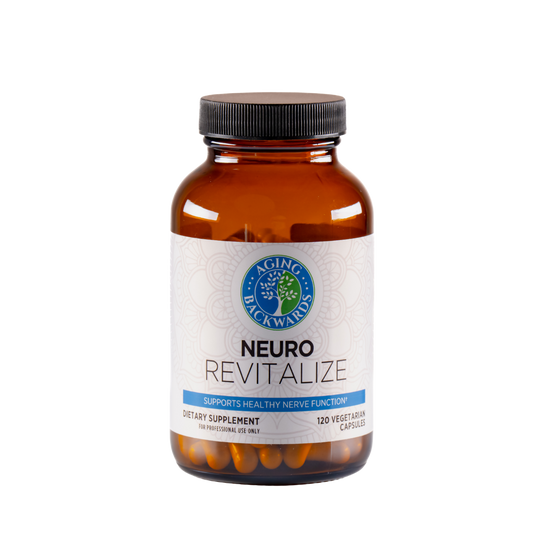
That is how Neuro Revitalize™ is built. Acetyl-L-carnitine (ALC), benfotiamine (a fat-soluble form of vitamin B1), and R-lipoic acid all work at the doorway where fuel enters the mitochondria. The three B vitamins — methylcobalamin B12, methylfolate and active B6 — run the methylation cycle that maintains myelin and keeps homocysteine in check. Two meta-analyses of more than 1,700 people with multiple sclerosis found homocysteine runs higher than in controls, even when B12 and folate look normal [12].
What the research shows
Fatigue. In 36 people with multiple sclerosis, 2 grams of ALC a day went head-to-head with amantadine, the standard fatigue drug, three months each. Fatigue scores fell on ALC and drifted up on amantadine; five people quit amantadine for side effects, one quit ALC [1]. Results varied with how long people took it: a second trial ran one month and saw no separation from placebo [2], and Cochrane wants a larger trial before drawing a conclusion [3]. Our read: three months showed the difference, so give it three months.
Thiamine, too: in 15 people with relapsing multiple sclerosis, all with normal blood thiamine, high-dose thiamine cut fatigue scores 41% within days [6]. It was an open study without a placebo arm, so it's early data pointing the right way, and it is why benfotiamine, which delivers roughly eleven times the plasma thiamine of ordinary B1 [9], earns its place.
Nerve comfort. The trials that tested this were in people with diabetic neuropathy, and the nerve-energy biology they worked on is the same. Across two year-long trials in 1,257 people, ALC improved pain and vibration sense and, on nerve biopsy, increased regenerating fibers [4]. Benfotiamine at 300–600 mg improved neuropathy symptom scores in six weeks, pain responding best [7].
Brain and mood. In 70 adults with early memory loss, 600 mg of benfotiamine daily for a year slowed functional decline 77% [8]. Across 12 trials, ALC lifted depressive symptoms about as well as antidepressants, with fewer side effects [5].
Lipoic acid. This one has the most multiple sclerosis research of the six. At 1,200 mg, a two-year trial in 51 people with secondary progressive multiple sclerosis found 68% less brain shrinkage and fewer falls [10]; in the larger follow-up, brain volume again held steadier, while walking speed did not change [11]. Our 200 mg of the R-form is a mitochondrial-cofactor dose — a dose your doctor can build on if you want the trial range — and well under the dose that caused stomach upset and urine protein in the big study [11].
Why we're comfortable with this formula
Every form is the active one: methylcobalamin; methylfolate, which bypasses the MTHFR step one in ten of us does slowly [15]; P5P, the coenzyme form of B6, at a quarter of the safety ceiling [14]. Benfotiamine matches the lower arm of its neuropathy trial [7]; ALC at 1 gram matches the neuropathy trials [4] and is half the multiple sclerosis fatigue-trial dose — a dose your doctor can build on if fatigue is the main target. B12 at 2,000 mcg is practical: only about 1% of a dose that size is absorbed [16], so it lands where it corrects a real shortfall. Unexplained low B12 has been documented in people with multiple sclerosis since 1991 [13], and B12 deficiency can mimic multiple sclerosis on an MRI.
At a glance: how much to take
The label is your starting point, not your ceiling. The trials behind this product often used more, and the rows below show where the research went. Anything above the label is a conversation to have with your own physician — bring the numbers with you.
| Situation | How much | Notes |
|---|---|---|
| Start here (label) | 2 capsules with breakfast, 2 with lunch | With fat; give it 12 weeks; not late in the day (ALC can keep you up) |
| Easing in | 2 capsules a day with breakfast for week 1, then 4 | — |
| Fatigue or neuropathy flare | Stay at 4 — don't exceed (B6 adds up) | Ask your doctor about adding plain acetyl-L-carnitine to reach the 2 g fatigue-trial dose |
| Pharmacist first | — | Warfarin, insulin or sulfonylurea, levothyroxine (separate by 4 h), methotrexate, seizure medicines |
| Multiple sclerosis relapse or new symptoms | Don't change any dose on your own | Call your neurologist first |
If this is you
The two o'clock fatigue and the foggy, slow brain. Take 2 capsules with breakfast and 2 with lunch — the trials divided their doses, and ALC late in the day can keep you up. Eat fat with them (eggs, avocado, salmon). Give it 12 weeks, as the ALC trial did. Ask your doctor for a baseline B12 and homocysteine to see what moved — and read them against tighter targets than the lab's flags. Most labs call homocysteine "normal" up to 15; an international consensus of researchers concluded that anything above 11 is already a cause of brain shrinkage and cognitive decline, and treatment is warranted above 10 [19]. We like to see it in the single digits. For B12, the lab's "low" flag sits around 200 pg/mL, but nerve-related deficiency is common between 200 and 400, and the level that protects the nervous system is above 500 — the cutoff Japan has used for decades [20].
Buzzing, burning or numb feet and hands. Same 4 capsules daily, and be patient: the nerve-regrowth data took a year [4]. Never push through new or worsening numbness — stop and call your neurologist.
You take warfarin, insulin or a sulfonylurea, levothyroxine, methotrexate, or a seizure medicine. Pharmacist first. Carnitine has pushed INR up in two published cases [17]; lipoic acid and benfotiamine can lower blood sugar; lipoic acid may affect thyroid conversion, so separate it from levothyroxine by four hours; methylfolate can blunt methotrexate and lower some seizure-drug levels [15].
Whichever route you've chosen for the disease itself. Some in our community take a disease-modifying therapy; some, with their doctors, have chosen not to. The dose is the same either way. On a DMT, no interaction is documented; the ALC trial included people on interferon. Off a DMT, nerve energy and methylation are doing more of the work on their own — so the baseline B12 (aim above 500) and homocysteine (aim under 10, ideally single digits), and the three-month recheck, are how you know it's working.
A short safety word: no interaction with any disease-modifying therapy has been documented — the ALC trial included people on interferon [1] — but tell your neurologist anyway. If you take other B6, add it up and stay under 100 mg a day [14]. Skip it in pregnancy or nursing unless your obstetric provider agrees.
Where Tami landed
"The afternoon wall was the part of MS nobody could see. I didn't fix it with willpower. I fed it. My thinking came back first, then the two o'clock slump stopped owning my day."
That's where I land too. Nerves asked to work twice as hard deserve to be fed, and these are the six nutrients the biology and the human trials point to.
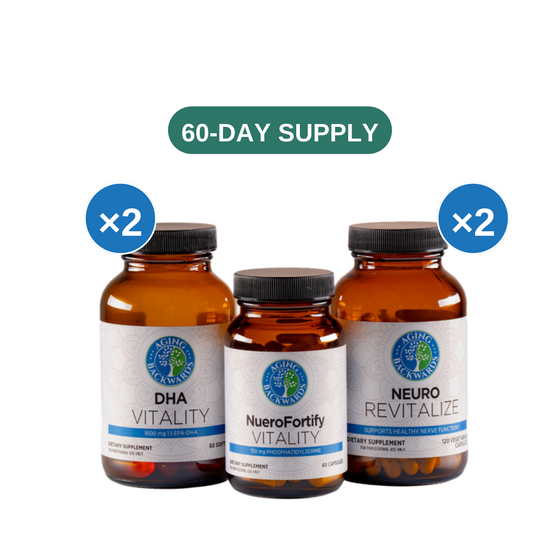
Neuro Revitalize™ is part of the Neuro Vitality Package™ at agingbackwardswellness.com. If the afternoon wall is your multiple sclerosis, start here.
References
- Tomassini V, Pozzilli C, Onesti E, et al. Comparison of the effects of acetyl L-carnitine and amantadine for the treatment of fatigue in multiple sclerosis: results of a pilot, randomised, double-blind, crossover trial. J Neurol Sci. 2004;218(1-2):103–108. https://doi.org/10.1016/j.jns.2003.11.005
- Ledinek AH, Sajko MC, Rot U. Evaluating the effects of amantadin, modafinil and acetyl-L-carnitine on fatigue in multiple sclerosis — result of a pilot randomized, blind study. Clin Neurol Neurosurg. 2013;115(Suppl 1):S86–S89. PMID 24321164. https://doi.org/10.1016/j.clineuro.2013.09.029
- Tejani AM, Wasdell M, Spiwak R, Rowell G, Nathwani S. Carnitine for fatigue in multiple sclerosis. Cochrane Database Syst Rev. 2021;11:CD007280. https://doi.org/10.1002/14651858.CD007280.pub3
- Sima AAF, Calvani M, Mehra M, Amato A. Acetyl-L-carnitine improves pain, nerve regeneration, and vibratory perception in patients with chronic diabetic neuropathy: an analysis of two randomized placebo-controlled trials. Diabetes Care. 2005;28(1):89–94. PMID 15616239. https://pubmed.ncbi.nlm.nih.gov/15616239/
- Veronese N, Stubbs B, Solmi M, Ajnakina O, Carvalho AF, Maggi S. Acetyl-L-carnitine supplementation and the treatment of depressive symptoms: a systematic review and meta-analysis. Psychosom Med. 2018;80(2):154–159. PMID 29076953. https://doi.org/10.1097/PSY.0000000000000537
- Costantini A, Nappo A, Pala MI, Zappone A. High dose thiamine improves fatigue in multiple sclerosis. BMJ Case Rep. 2013;2013:bcr2013009144. PMID 23861280. https://doi.org/10.1136/bcr-2013-009144
- Stracke H, Gaus W, Achenbach U, Federlin K, Bretzel RG. Benfotiamine in diabetic polyneuropathy (BENDIP): results of a randomised, double blind, placebo-controlled clinical study. Exp Clin Endocrinol Diabetes. 2008;116(10):600–605. PMID 18473286. https://doi.org/10.1055/s-2008-1065351
- Gibson GE, Luchsinger JA, Cirio R, et al. Benfotiamine and cognitive decline in Alzheimer's disease: results of a randomized placebo-controlled phase IIa clinical trial. J Alzheimers Dis. 2020;78(3):989–1010. PMID 33074237. https://doi.org/10.3233/JAD-200896
- Xie F, Cheng Z, Li S, et al. Pharmacokinetic study of benfotiamine and the bioavailability assessment compared to thiamine hydrochloride. J Clin Pharmacol. 2014;54(6):688–695. PMID 24399744. https://doi.org/10.1002/jcph.261
- Spain R, Powers K, Murchison C, et al. Lipoic acid in secondary progressive MS: a randomized controlled pilot trial. Neurol Neuroimmunol Neuroinflamm. 2017;4(5):e374. PMID 28680916. https://doi.org/10.1212/NXI.0000000000000374
- Spain RI, Paz Soldán MM, Freedman MS, et al. Lipoic acid for treatment of progressive multiple sclerosis: a phase 2 randomized clinical trial. Neurology. 2026;106(1):e214454. PMID 41397213. https://doi.org/10.1212/WNL.0000000000214454
- Li X, Yuan J, Han J, Hu W. Serum levels of homocysteine, vitamin B12 and folate in patients with multiple sclerosis: an updated meta-analysis. Int J Med Sci. 2020;17(6):751–761. https://doi.org/10.7150/ijms.42058 — and Dardiotis E, et al. Mult Scler Relat Disord. 2017;17:190–197. https://doi.org/10.1016/j.msard.2017.08.004
- Reynolds EH, Linnell JC, Faludy JE. Multiple sclerosis associated with vitamin B12 deficiency. Arch Neurol. 1991;48(8):808–811. PMID 1898255. https://doi.org/10.1001/archneur.1991.00530200044017
- National Institutes of Health, Office of Dietary Supplements. Vitamin B6 — Fact Sheet for Health Professionals. Updated June 16, 2023. https://ods.od.nih.gov/factsheets/VitaminB6-HealthProfessional/
- National Institutes of Health, Office of Dietary Supplements. Folate — Fact Sheet for Health Professionals. https://ods.od.nih.gov/factsheets/Folate-HealthProfessional/
- National Institutes of Health, Office of Dietary Supplements. Vitamin B12 — Fact Sheet for Health Professionals. Updated July 2, 2025. https://ods.od.nih.gov/factsheets/VitaminB12-HealthProfessional/
- Bachmann HU, Hoffmann A. Interaction of food supplement L-carnitine with oral anticoagulant acenocoumarol. Swiss Med Wkly. 2004;134(25-26):385. https://doi.org/10.4414/smw.2004.10631
- Witte ME, Mahad DJ, Lassmann H, van Horssen J. Mitochondrial dysfunction contributes to neurodegeneration in multiple sclerosis. Trends Mol Med. 2014;20(3):179–187. https://doi.org/10.1016/j.molmed.2013.11.007
- Smith AD, Refsum H, Bottiglieri T, et al. Homocysteine and dementia: an international consensus statement. J Alzheimers Dis. 2018;62(2):561–570. https://doi.org/10.3233/JAD-171042
- Langan RC, Goodbred AJ. Vitamin B12 deficiency: recognition and management. Am Fam Physician. 2017;96(6):384–389. PMID 28925645. https://www.aafp.org/pubs/afp/issues/2017/0915/p384.html
These statements have not been evaluated by the Food and Drug Administration. This product is not intended to diagnose, treat, cure, or prevent any disease. This article is educational and reflects published research; it is not medical advice and does not create a doctor–patient relationship. Multiple sclerosis is a serious condition — please discuss any supplement with your neurologist or physician, especially if you take a disease-modifying therapy or other prescription medications.
Aging Backwards Wellness · Manti, Utah · agingbackwardswellness.com