





By Dr. Ben Wright, DO — Aging Backwards Wellness, Manti, Utah
You're mid-sentence and the word is just gone. You read the same paragraph three times. Someone asks a simple question and there's a lag before your brain catches up. Our community calls it brain fog, the symptom nobody warned them about.
Tami knows it. After her diagnosis, when she was told to plan on a cane, the foggy days worried her more than the numbness did. She's on a tennis court now, keeping up with her kids, and the fog is still what she guards against most. Here's what the research supports.
Why phosphatidylserine matters when you have multiple sclerosis
Cognitive change is one of the most common parts of multiple sclerosis; a third to two-thirds of people notice it, usually as slower processing speed and a less reliable memory [1]. It isn't "all in your head"; it's in your nerve cells.
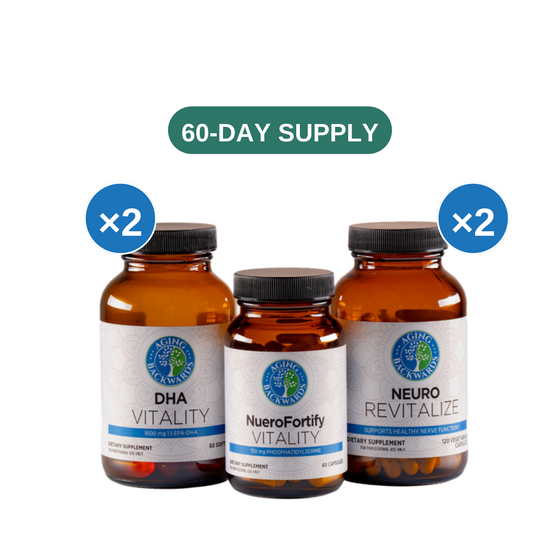
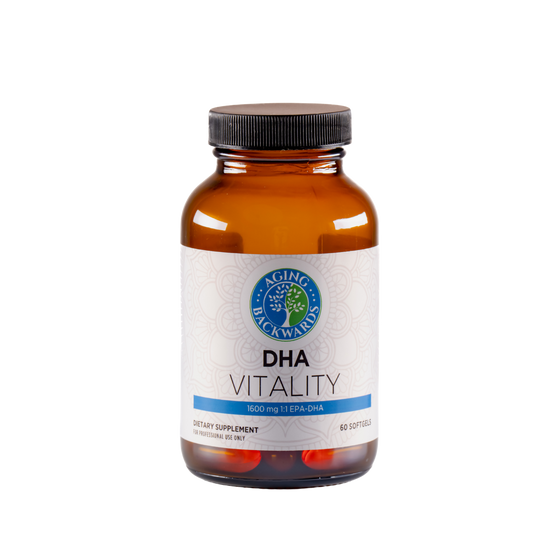
Every nerve cell is wrapped in a membrane, and phosphatidylserine (PS) is one of its main building blocks, roughly 15% of the phospholipid in your cortex [2]. It sits on the inside face of the membrane as a docking station: the signaling proteins that keep neurons alive, grow new branches, and form connections anchor to PS [2]. Brain PS naturally carries DHA, the omega-3 fat [3], which is why PS and DHA Vitality™ share a package.
What the research shows
Forty years of trials have tested PS in older adults with memory complaints, plus stress-hormone studies in healthy and stressed adults, and they tell a useful story. The trials weren't in people with multiple sclerosis — that study hasn't been done yet, and we'll say so when it is — but the membrane biology is the same.
The largest trial: 494 older adults with cognitive decline took 300 mg of PS or placebo for six months, and the PS group improved significantly on memory and behavior [4]. A US trial of 149 adults with age-related memory impairment found the same at 12 weeks, and those who started lowest benefited most [5].
The record since is strong where it should be. Results varied with how much room people had to improve: a Dutch trial at 300 and 600 mg saw no change over 12 weeks in people who started near normal [6], while in a six-month Japanese trial of 78 adults, those with weaker baseline memory improved on delayed word recall versus placebo, and 100 mg a day worked as well as 300 [7]. A 15-week trial of 157 older adults on a PS-DHA combination improved verbal recall [8]; when the placebo group later started 100 mg a day, attention and memory scores rose and the share rated "improved" climbed from 28% to 44% [9].
The pattern: PS helps most where there's ground to make up, 100 mg is a real dose, and the trial that saw no change was the one with the least ground to make up and the shortest window.
The second story is cortisol. In healthy men, 600 mg of PS for ten days cut the cortisol spike after hard exercise by about 39% [10]. In chronically stressed men, a PS complex normalized the stress-hormone response; relaxed men didn't change [11]. Same lesson: it restores, it doesn't rev.
Why we're comfortable with this formula
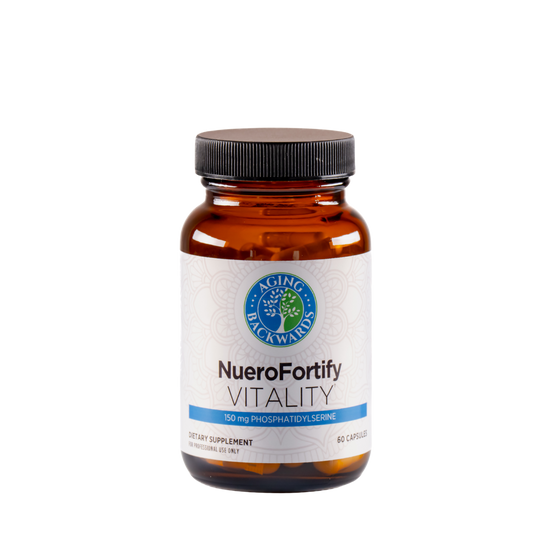
NeuroFortify Vitality™ is 150 mg of plant-derived PS, soy-free, one capsule a day — inside the 100–300 mg range the memory trials used and above the 100 mg that moved scores in two of them. It is the same PS molecule your brain's signaling proteins dock to, in a form that needs no soy.
Brain PS carries DHA, and the PS products that performed best in trials carried DHA with them [3,8]. NeuroFortify alongside DHA Vitality™ gives your membranes both halves of the molecule they build with; the pairing rests on that shared biology rather than a head-to-head trial of the two products, and it's why they share a package.
At a glance: how much to take
The label is your starting point, not your ceiling. The trials behind this product often used more, and the rows below show where the research went. Anything above the label is a conversation to have with your own physician — bring the numbers with you.
| Situation | How much | Notes |
|---|---|---|
| Start here (label) | 1 capsule with a meal that has fat | Give it 12 weeks |
| Foggy or high-stress stretch | 2 capsules a day (300 mg, the most common memory-trial dose) | Ask your doctor before going above the label; cortisol trials used 400–800 mg |
| Ask first | — | Blood thinners, anticholinergic bladder medicines, blood-pressure medicine; clear it in pregnancy |
| Multiple sclerosis relapse or new symptoms | Don't change any dose on your own | Call your neurologist first |
If this is you
Word-finding trouble, slow thinking, "I read it three times." Take 1 capsule daily with a meal that has fat: eggs, avocado, salmon, olive oil on vegetables. Give it 12 weeks; the memory trials ran 12 weeks to 6 months [4,5,7]. If the fog is new or suddenly worse, call your neurologist first.
Wired, exhausted, running on stress hormones. The cortisol trials used 400–800 mg [10,11]. Ask your doctor before taking more than one capsule; two (300 mg) matches the most common memory-trial dose.
On blood thinners, bladder medications with anticholinergic effects, or blood-pressure medication. Interactions are theoretical, not documented, but PS lowered blood pressure a few points in two studies [9,12] and is part of normal clotting biology. Ask your pharmacist first.
Whichever route you've chosen for the disease itself. Some in our community take a disease-modifying therapy; some, with their doctors, have chosen not to. The dose is the same either way. On a DMT, no interaction is documented. Off a DMT, there's nothing to weigh; membrane support is part of what you're relying on, so pair it with DHA Vitality™ and give it the full 12 weeks.
A short safety word: in trials up to 600 mg a day for months, including a 157-person safety study, PS caused no lab changes and no more side effects than placebo [6,13]; occasional stomach upset is the main complaint. We found no documented interaction with any disease-modifying therapy, but tell your neurologist anyway. Skip it in pregnancy or nursing unless your obstetric provider agrees.
Where Tami landed
"The fog was the thing I couldn't explain to anyone. I didn't look sick; I just couldn't find my words. PS isn't a one-day fix. Stacked with the fish oil and real sleep, it's part of why I have more sharp days than foggy ones now. I don't skip it."
That's where I land too. PS is foundational: it is literally what the membrane is made of, the people who needed it in the trials improved, and this capsule is a dose that worked. It earns its place.
NeuroFortify Vitality™ is part of the Neuro Vitality Package™ at agingbackwardswellness.com. If your brain feels slow, start by giving it what it's built from.
References
- Benedict RHB, Amato MP, DeLuca J, Geurts JJG. Cognitive impairment in multiple sclerosis: clinical management, MRI, and therapeutic avenues. Lancet Neurol. 2020;19(10):860–871. https://doi.org/10.1016/S1474-4422(20)30277-5
- Kim HY, Huang BX, Spector AA. Phosphatidylserine in the brain: metabolism and function. Prog Lipid Res. 2014;56:1–18. PMID 24992464. https://doi.org/10.1016/j.plipres.2014.06.002
- Mozzi R, Buratta S, Goracci G. Metabolism and functions of phosphatidylserine in mammalian brain. Neurochem Res. 2003;28(2):195–214. PMID 12608694.
- Cenacchi T, Bertoldin T, Farina C, Fiori MG, Crepaldi G. Cognitive decline in the elderly: a double-blind, placebo-controlled multicenter study on efficacy of phosphatidylserine administration. Aging (Milano). 1993;5(2):123–133. PMID 8323999.
- Crook TH, Tinklenberg J, Yesavage J, Petrie W, Nunzi MG, Massari DC. Effects of phosphatidylserine in age-associated memory impairment. Neurology. 1991;41(5):644–649. PMID 2027477. https://doi.org/10.1212/wnl.41.5.644
- Jorissen BL, Brouns F, Van Boxtel MP, Ponds RW, Verhey FR, Jolles J. The influence of soy-derived phosphatidylserine on cognition in age-associated memory impairment. Nutr Neurosci. 2001;4(2):121–134. PMID 11842880. https://doi.org/10.1080/1028415X.2001.11747356
- Kato-Kataoka A, Sakai M, Ebina R, Nonaka C, Asano T, Miyamori T. Soybean-derived phosphatidylserine improves memory function of the elderly Japanese subjects with memory complaints. J Clin Biochem Nutr. 2010;47(3):246–255. PMID 21103034. https://doi.org/10.3164/jcbn.10-62
- Vakhapova V, Cohen T, Richter Y, Herzog Y, Korczyn AD. Phosphatidylserine containing ω-3 fatty acids may improve memory abilities in non-demented elderly with memory complaints: a double-blind placebo-controlled trial. Dement Geriatr Cogn Disord. 2010;29(5):467–474. PMID 20523044. https://doi.org/10.1159/000310330
- Vakhapova V, Cohen T, Richter Y, Herzog Y, Kam Y, Korczyn AD. Phosphatidylserine containing omega-3 fatty acids may improve memory abilities in nondemented elderly individuals with memory complaints: results from an open-label extension study. Dement Geriatr Cogn Disord. 2014;38(1-2):39–45. PMID 24577097. https://doi.org/10.1159/000357793
- Starks MA, Starks SL, Kingsley M, Purpura M, Jäger R. The effects of phosphatidylserine on endocrine response to moderate intensity exercise. J Int Soc Sports Nutr. 2008;5:11. PMID 18662395. https://doi.org/10.1186/1550-2783-5-11
- Hellhammer J, Vogt D, Franz N, Freitas U, Rutenberg D. A soy-based phosphatidylserine/phosphatidic acid complex (PAS) normalizes the stress reactivity of hypothalamus-pituitary-adrenal-axis in chronically stressed male subjects: a randomized, placebo-controlled study. Lipids Health Dis. 2014;13:121. PMID 25081826. https://doi.org/10.1186/1476-511X-13-121
- Richter Y, Herzog Y, Lifshitz Y, Hayun R, Zchut S. The effect of soybean-derived phosphatidylserine on cognitive performance in elderly with subjective memory complaints: a pilot study. Clin Interv Aging. 2013;8:557–563. PMID 23723695. https://doi.org/10.2147/CIA.S40348
- Vakhapova V, Richter Y, Cohen T, Herzog Y, Korczyn AD. Safety of phosphatidylserine containing omega-3 fatty acids in non-demented elderly: a double-blind placebo-controlled trial followed by an open-label extension. BMC Neurol. 2011;11:79. https://doi.org/10.1186/1471-2377-11-79
These statements have not been evaluated by the Food and Drug Administration. This product is not intended to diagnose, treat, cure, or prevent any disease. This article is educational and reflects published research; it is not medical advice and does not create a doctor–patient relationship. Multiple sclerosis is a serious condition — please discuss any supplement with your neurologist or physician, especially if you take a disease-modifying therapy or other prescription medications.
Aging Backwards Wellness · Manti, Utah · agingbackwardswellness.com