





By Dr. Ben Wright, DO — Aging Backwards Wellness, Manti, Utah
There's a version of multiple sclerosis nobody puts on the pamphlet. The belly weight that showed up after the steroids and never left. The bloat that's there by two in the afternoon no matter what you ate. The fasting glucose your family doctor called "a little high, we'll watch it," that your neurologist never mentioned.
Tami lived in that gap for years. Her legs and energy were the headline; the scale and the sugar could wait "until the multiple sclerosis was handled." They turned out to be the same problem.
Berberine is what we reach for first when gut and metabolism both need a reset.
Why metabolism belongs in a multiple sclerosis conversation
Among 8,983 people with multiple sclerosis, each vascular problem (diabetes, high blood pressure, high cholesterol, heart disease) raised the odds of early walking disability by about 50%, and the median time to needing a cane dropped from 18.8 years to 12.8 [15]. A Swedish cohort found the same for weight [16].
Those are population studies of risk factors rather than berberine trials, and the message is the same: the multiple sclerosis you can't see — the sugar, the lipids, the weight — quietly steers the multiple sclerosis you can.
What berberine actually does
Berberine is a bitter yellow alkaloid from Berberis aristata, and less than 1% of it is absorbed. That's the design, not a flaw: most of each dose stays in your gut, working on the bacteria there [12].
In the PREMOTE trial — 409 adults, randomized and double-blinded — twelve weeks of berberine trimmed back starch-fermenting species, increased Bacteroides, and lowered a secondary bile acid tied to gut irritation [3]. In animals it shifted the microbiome toward butyrate producers [12, 13]. And in 104 people with small-intestinal bacterial overgrowth — a common root of stubborn bloat — a berberine-based herbal protocol normalized breath tests at least as often as the antibiotic rifaximin [4].
The fraction that is absorbed flips AMPK, your cells' energy sensor, nudging them to burn fuel instead of storing it [14] — the same switch metformin uses.
What the research says
In 2008, 36 adults with new type 2 diabetes were randomized to berberine or metformin for three months, and the glucose-lowering was essentially the same — HbA1c fell from 9.5% to 7.5% on berberine [1]. A meta-analysis of 27 randomized trials confirmed it: lower glucose and HbA1c, no significant difference from oral diabetes drugs, better lipids and blood pressure, no serious adverse events [2]. That is metformin-level human evidence. The trials were in people with type 2 diabetes rather than multiple sclerosis, and the metabolism they studied is the same one you carry.
The multiple sclerosis-specific piece lives in the mouse model: berberine lowered IL-17 — the signal from the Th17 cells that keep multiple sclerosis inflammation running hot — expanded the regulatory T cells that act as brakes, and reduced MMP-9, the enzyme immune cells use to loosen the blood–brain barrier [5–7]. The metabolic, gut and immune data all point one way; berberine hasn't been through a randomized trial in people with multiple sclerosis yet, and we'll say so when it has.
The 50 mg of alpha-lipoic acid in the capsule is a supporting antioxidant that activates AMPK alongside berberine [14, 17]. ALA has its own multiple sclerosis trials at 1,200 mg a day, where results varied [8, 9]; at 50 mg it's here to back up the berberine, which does the heavy lifting.
At a glance: how much to take
The label is your starting point, not your ceiling. The trials behind this product often used more, and the rows below show where the research went. Anything above the label is a conversation to have with your own physician — bring the numbers with you.
| Situation | How much | Notes |
|---|---|---|
| Start here (label) — reset block | 1 capsule with breakfast, 1 with dinner, for 3 months | Glucose/A1c and lipids before and after; A1c target 5.0–5.4% |
| Doctor-guided higher range | Up to 3 capsules a day (1,200 mg), inside the 900–1,500 mg the diabetes trials used [1, 2] | Discuss with your physician first; stomach complaints rose toward the top of that range |
| Sensitive gut | 1 capsule a day with food for week 1, then 2 | Gas or loose stools early on are common and settle |
| Between blocks | Off, or 1 capsule daily if your doctor wants ongoing metabolic support | A reset, not a residence |
| Pharmacist first | — | Siponimod, ozanimod, fingolimod, warfarin, diabetes medicines, many statins and antidepressants. Never in pregnancy or nursing |
| Multiple sclerosis relapse or new symptoms | Don't change any dose on your own | Call your neurologist first |
If this is you
Belly weight that won't move, or an A1c or fasting glucose creeping up. Take one capsule with breakfast and one with dinner, the way the trials did it. Our 800 mg a day sits just under the 900–1,500 mg used in most trials, below the doses where stomach complaints climbed [1, 2]. Ask your doctor for a fasting glucose or HbA1c and a lipid panel before you start, run a three-month block, then repeat them. Don't settle for "not diabetic": in 15,869 adults without diabetes, the lowest death risk sat at an HbA1c of about 5.4%, and risk climbed above that long before the 5.7% prediabetes line [19]. The range we like is 5.0–5.4%. Bloat usually shifts within weeks; the numbers follow at three months.
Stubborn bloat with a touchy gut. Start with one capsule a day with food for the first week, then go to two. About one in three people in the 2008 trial had gas or loose stools early on [1]. Treat it as a reset, not a residence: berberine clears the ground so Probio Vitality™ can reseed, Butyrate Gut Vitality™ can feed the lining, and IgGI can clean up what's left. Plan a defined block of three to twelve months, then reassess with your own doctor.
You take siponimod (Mayzent), ozanimod (Zeposia), fingolimod (Gilenya), warfarin, or a diabetes medicine. Talk to your pharmacist or doctor before the first capsule. Berberine inhibits several liver enzymes that clear medications — CYP3A4, CYP2D6 and CYP2C9 — and in transplant patients it raised cyclosporine levels by about a third [10, 11]. Siponimod is cleared by CYP2C9 and CYP3A4, the two enzymes berberine affected most; ozanimod partly uses CYP3A4; fingolimod uses a different pathway, so the concern is lower. Berberine hasn't been studied alongside any DMT directly, so this caution rests on the enzyme biology — and a five-minute pharmacist conversation is all it takes to settle it. If you take insulin or a sulfonylurea, watch your sugars closely.
Whichever route you've chosen for the disease itself. Some in our community take a disease-modifying therapy; some, with their doctors, have chosen not to. The dose and the three-month block are the same either way. On an oral DMT, the liver-enzyme check above is the whole conversation. Off a DMT, that concern disappears — but the diabetes-medication, blood-thinner and pregnancy cautions still apply, and the before-and-after labs are how you know it worked.
The same enzymes handle many statins and several antidepressants, so bring your full medication list. Skip berberine entirely if you're pregnant or nursing [18].
Where Tami landed
"For years I thought the belly and the bloat were just what my body did now. A few months of berberine was the first time the ground got firmer — my sugar came down, the two o'clock bloat went away, and the rest of the gut protocol finally had something to build on. I don't take it year-round. I take it when it's time to reset."
That's how I'd put it too. Berberine clears the ground so everything else can grow, and its human research is as solid as the natural world gets.
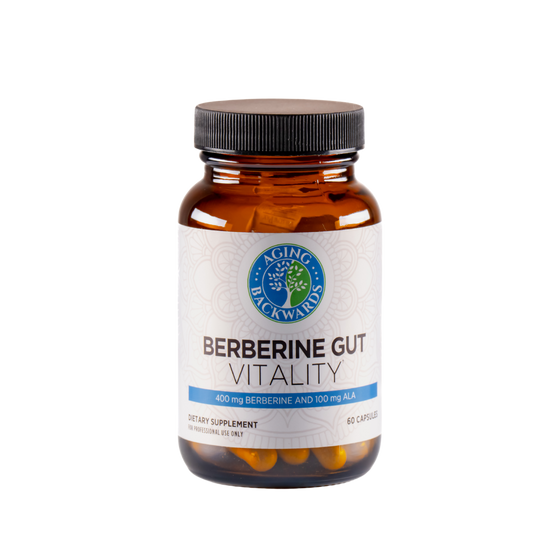
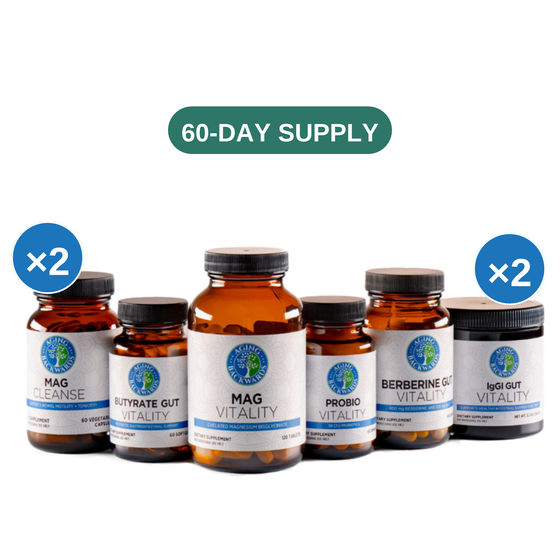
Berberine Gut Vitality™ is part of the Gut Vitality Package™ at agingbackwardswellness.com. If the bloat won't leave and the numbers keep creeping, this is where the reset begins.
References
- Yin J, Xing H, Ye J. Efficacy of berberine in patients with type 2 diabetes mellitus. Metabolism. 2008;57(5):712–717. PMID 18442638. https://doi.org/10.1016/j.metabol.2008.01.013
- Lan J, Zhao Y, Dong F, et al. Meta-analysis of the effect and safety of berberine in the treatment of type 2 diabetes mellitus, hyperlipemia and hypertension. J Ethnopharmacol. 2015;161:69–81. PMID 25498346. https://doi.org/10.1016/j.jep.2014.09.049
- Zhang Y, Gu Y, Ren H, et al. Gut microbiome-related effects of berberine and probiotics on type 2 diabetes (the PREMOTE study). Nat Commun. 2020;11:5015. PMID 33024120. https://doi.org/10.1038/s41467-020-18414-8
- Chedid V, Dhalla S, Clarke JO, et al. Herbal therapy is equivalent to rifaximin for the treatment of small intestinal bacterial overgrowth. Glob Adv Health Med. 2014;3(3):16–24. PMID 24891990. https://doi.org/10.7453/gahmj.2014.019
- Tavaf MJ, Soltanmohammadi A, Zargarani S, et al. Berberine promotes immunological outcomes and decreases neuroinflammation in the experimental model of multiple sclerosis through the expansion of Treg and Th2 cells. Immun Inflamm Dis. 2023;11(1):e766. PMID 36705421. https://doi.org/10.1002/iid3.766
- Ma X, Jiang Y, Wu A, et al. Berberine attenuates experimental autoimmune encephalomyelitis in C57 BL/6 mice. PLoS One. 2010;5(10):e13489. PMID 20976070. https://doi.org/10.1371/journal.pone.0013489
- Jiang Y, Wu A, Zhu C, et al. The protective effect of berberine against neuronal damage by inhibiting matrix metalloproteinase-9 and laminin degradation in experimental autoimmune encephalomyelitis. Neurol Res. 2013;35(4):360–368. PMID 23540404. https://doi.org/10.1179/1743132812Y.0000000156
- Spain R, Powers K, Murchison C, et al. Lipoic acid in secondary progressive MS: a randomized controlled pilot trial. Neurol Neuroimmunol Neuroinflamm. 2017;4(5):e374. PMID 28680916. https://doi.org/10.1212/NXI.0000000000000374
- Spain RI, Paz Soldán MM, Freedman MS, et al. Lipoic acid for treatment of progressive multiple sclerosis: a phase 2 randomized clinical trial. Neurology. 2026;106(1):e214454. PMID 41397213. https://doi.org/10.1212/WNL.0000000000214454
- Guo Y, Chen Y, Tan ZR, Klaassen CD, Zhou HH. Repeated administration of berberine inhibits cytochromes P450 in humans. Eur J Clin Pharmacol. 2012;68(2):213–217. PMID 21870106. https://doi.org/10.1007/s00228-011-1108-2
- Wu X, Li Q, Xin H, Yu A, Zhong M. Effects of berberine on the blood concentration of cyclosporin A in renal transplanted recipients: clinical and pharmacokinetic study. Eur J Clin Pharmacol. 2005;61(8):567–572. PMID 16133554. https://doi.org/10.1007/s00228-005-0952-3
- Feng R, Zhao ZX, Ma SR, Guo F, Wang Y, Jiang JD. Gut microbiota-regulated pharmacokinetics of berberine and active metabolites in beagle dogs after oral administration. Front Pharmacol. 2018;9:214. https://doi.org/10.3389/fphar.2018.00214
- Wang Y, Shou JW, Li XY, et al. Berberine-induced bioactive metabolites of the gut microbiota improve energy metabolism. Metabolism. 2017;70:72–84. PMID 28403947. https://pubmed.ncbi.nlm.nih.gov/28403947/
- Lee YS, Kim WS, Kim KH, et al. Berberine, a natural plant product, activates AMP-activated protein kinase with beneficial metabolic effects in diabetic and insulin-resistant states. Diabetes. 2006;55(8):2256–2264. PMID 16873688. https://pubmed.ncbi.nlm.nih.gov/16873688/
- Marrie RA, Rudick R, Horwitz R, et al. Vascular comorbidity is associated with more rapid disability progression in multiple sclerosis. Neurology. 2010;74(13):1041–1047. PMID 20350978. https://doi.org/10.1212/WNL.0b013e3181d6b125
- Alfredsson L, Guo J, Johansson E, Olsson T, Hedström AK. Early-life and adult body mass index in relation to MS disability progression. J Neurol. 2025;272(9):571. PMID 40796951. https://doi.org/10.1007/s00415-025-13319-2
- Waslo C, Bourdette D, Gray N, Wright K, Spain R. Lipoic acid and other antioxidants as therapies for multiple sclerosis. Curr Treat Options Neurol. 2019;21(6):26. PMID 31056714. https://pubmed.ncbi.nlm.nih.gov/31056714/
- Chan E. Displacement of bilirubin from albumin by berberine. Biol Neonate. 1993;63(4):201–208. PMID 8513024. https://doi.org/10.1159/000243932
- Wang Y, et al. Glycated hemoglobin and all-cause and cause-specific mortality among adults with and without diabetes. J Clin Endocrinol Metab. 2019;104(8):3345–3354. PMID 30896760. https://doi.org/10.1210/jc.2018-02536
These statements have not been evaluated by the Food and Drug Administration. This product is not intended to diagnose, treat, cure, or prevent any disease. This article is educational and reflects published research; it is not medical advice and does not create a doctor–patient relationship. Multiple sclerosis is a serious condition — please discuss any supplement with your neurologist or physician, especially if you take a disease-modifying therapy or other prescription medications.
Aging Backwards Wellness · Manti, Utah · agingbackwardswellness.com