




By Dr. Ben Wright, DO — Aging Backwards Wellness, Manti, Utah
It's a fair question, and our community asks it constantly. Your neurologist mentioned vitamin D. Why four more?
Tami asked me the same thing years ago, back when she was supposed to be measuring for a cane. I read the studies to see which pieces earned a spot. The answer to "why five" is that each one does a different job, and several of them work better together than alone.
Why an immune package matters when you have multiple sclerosis
Multiple sclerosis isn't a weak immune system; it's one that has lost some of its ability to tell self from non-self. So the goal is never to "boost" anything. It's balance, and fewer infections.
In a Dutch study of 73 people with relapsing multiple sclerosis, relapses were about twice as frequent in the weeks around an infection, and those relapses were nearly four times more likely to leave lasting deficit [1]. Fewer and shorter colds is a goal worth building a routine around, and that's what this package is for.
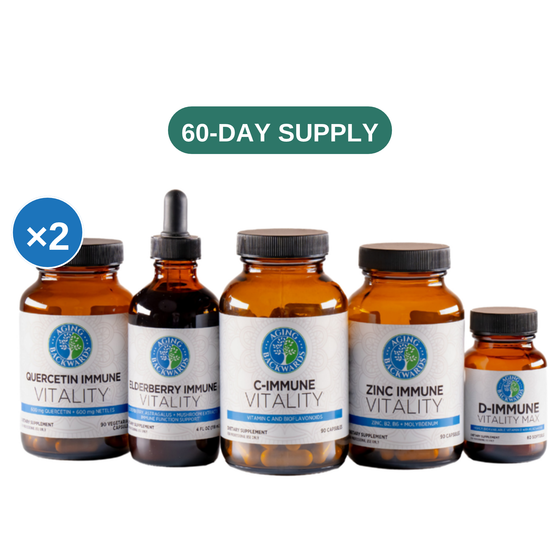
The five layers
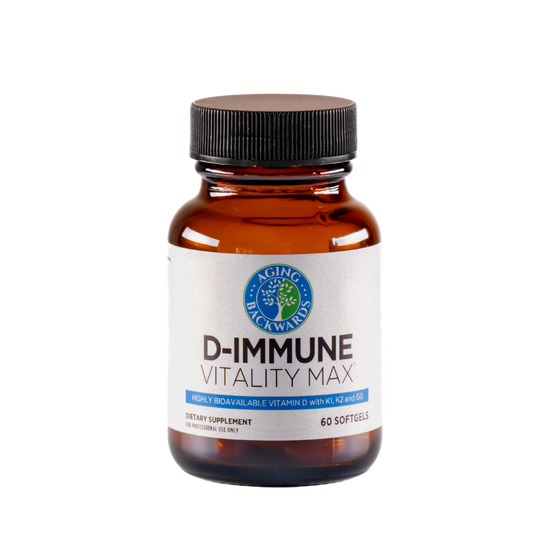
Vitamin D is the thermostat. In a randomized pilot of 40 people with relapsing multiple sclerosis, 10,400 IU a day — but not 800 IU — lowered the share of inflammatory IL-17-producing T cells [2]. In a 2025 trial of people with a first multiple sclerosis-type attack, high-dose vitamin D cut disease activity by about a third [5], and the trials that added it to standard therapy saw fewer new MRI lesions [3,4]. D-Immune Vitality Max™ is the anchor of the package, and the one we check with a lab.
Zinc is the mineral hub. The vitamin D receptor is literally built around zinc. Serum zinc runs modestly low in people with multiple sclerosis [6], and in the mouse model of multiple sclerosis zinc raised regulatory T cells and lowered Th17 cells [7]. Zinc appears in one product, at 30 mg — the amount that fills the gap without crowding out copper.
Vitamin C is the antioxidant base. Daily intake shortens colds and roughly halves them in people under heavy physical stress [8]; during a cold, white cells burn it fast, and the trials that dosed 6–8 g a day saw the shortest colds [16]. 600 mg daily keeps the tank full; the sick-day surge refills it.
Quercetin is the dimmer switch. In immune cells from people with relapsing multiple sclerosis, quercetin reduced proliferation and the loudest inflammatory signals, additively with interferon-beta [9].
Elderberry, astragalus, and mushroom beta-glucans are the botanical infection layer. Elderberry shortened colds and eased symptoms in several trials [10], with results varying by how early people started [11]. We dose it gently on purpose, so it supports your defenses without overstimulating a system that already runs warm.
How the five work together
Vitamin D with vitamin K — well supported. High-dose D increases calcium absorption. Vitamin K activates the proteins that put that calcium into bone and keep it out of artery walls; D raises their production, K switches them on [12]. People with multiple sclerosis carry roughly four times the hip-fracture risk of the general population [13]. That's why both share one softgel.
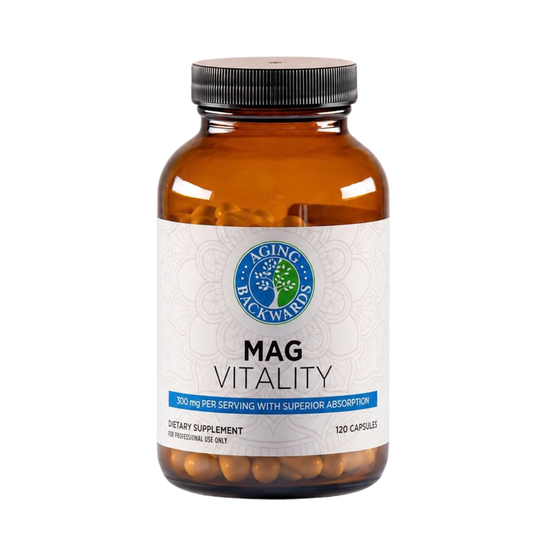
Vitamin D needs magnesium — well supported. The enzymes that activate vitamin D run on magnesium [14]. Magnesium isn't in this package; it's in the Gut Vitality Package™ (Mag Vitality™). Make sure it comes from somewhere.
Vitamin C with zinc — tested together. In a randomized trial of 94 adults with colds, a C-plus-zinc combination cleared symptoms faster than placebo [15].
The rest of the pairings rest on shared biology rather than head-to-head trials — the five-product combination itself hasn't been studied as a set, in multiple sclerosis or anywhere, and we'll always say so. What has been studied is each layer on its own, and the links that matter most (D with K, D with magnesium, C with zinc). That's what the package is built on.
At a glance: a simple day
Label doses are the starting point. Each product's own blog shows the range the research used; discuss anything above a label with your own physician.
| When | What | Notes |
|---|---|---|
| Breakfast (with fat) | D-Immune Max 1 softgel · C-Immune 1 capsule · Quercetin 2 capsules · Elderberry 2.5 mL | Fat drives absorption of D, K and quercetin |
| Lunch (with food) | Zinc 1 capsule | Away from iron or calcium |
| Dinner | Quercetin 1 capsule | Magnesium (from the Gut package) fits here too |
| First 3–5 days of a cold | C-Immune 2 capsules every 3–4 hours while awake; Elderberry 2.5 mL twice a day; Quercetin up to 5 capsules | Your white cells burn through vitamin C when they fight. Keep D and zinc steady; back to baseline when you're well. Ask your own doctor before going above any label |
| Multiple sclerosis relapse or new symptoms | Don't change any dose on your own | Call your neurologist first |
Blood vitamin D takes 8 to 12 weeks to plateau; judge the package at three months, not ten days.
If this is you
New to supplements, and five bottles feels like a lot. Start with the two anchors: the D-Immune Max softgel and one C-Immune at breakfast with fat. After a week, add Zinc at lunch. After two weeks, add Quercetin and Elderberry. Get magnesium from somewhere, and give the full package 12 weeks.
Already taking vitamin D or zinc from another bottle. Don't double. Swap D-Immune Max in for your current vitamin D, and tell whoever ordered it. Add up zinc from every source, multivitamin included, and keep the total under 40 mg a day — if your multi already has 15 mg or more, skip the Zinc bottle or alternate days.
On a disease-modifying therapy. Vitamin D labs apply regardless — 25-OH D and calcium at baseline and three months, aiming for 50–80 ng/mL (the D-Immune Max blog explains why that's higher than the lab's "normal"). On an oral DMT cleared by the liver, ask your neurologist about Quercetin specifically before starting it. On a strongly immunosuppressive DMT, ask about Elderberry, or leave it out.
Whichever route you've chosen for the disease itself. Some in our community take a disease-modifying therapy; some, with their doctors, have chosen not to. The package is the same either way. On a DMT, the specific checks are Quercetin (liver pathways) and Elderberry (strong immunosuppression). Off a DMT, there are no interactions to clear — and because fewer, shorter infections is one of your main levers, the daily habit, the vitamin D target and the sick-day surges matter more, not less.
The safety paragraph
Past three months, your doctor should check 25-OH vitamin D (target 50–80 ng/mL), calcium, kidney function, zinc (upper half of the range) and copper (in range). Excess zinc depletes copper, and copper deficiency can mimic multiple sclerosis in the spinal cord — so any new numbness on zinc deserves a copper level before anyone blames your multiple sclerosis. The 2,000 mcg of vitamin K in the D-Immune softgel will counteract warfarin; don't combine them without your prescriber's agreement. Skip the package in pregnancy and breastfeeding. Vitamin D was added to interferon and glatiramer in large trials without a safety signal [3,4].
Where we land
"When I was told to expect a cane, five bottles a day sounded like a lot. Now it's just breakfast — I think about it as much as brushing my teeth. And I'm on a tennis court four days a week."
That's Tami. Here's me: D works best with K and magnesium alongside it, zinc is built into the receptor D acts through, and the C, quercetin, and botanicals cover the infection side D doesn't touch. No single bottle does all that. Five do.
The Immune Vitality Max Package™ is at agingbackwardswellness.com. If vitamin D alone has never felt like enough, this is the rest of the answer.
References
- Buljevac D, et al. Prospective study on the relationship between infections and multiple sclerosis exacerbations. Brain. 2002;125(Pt 5):952-960. PMID 11960885.
- Sotirchos ES, et al. Safety and immunologic effects of high- vs low-dose cholecalciferol in multiple sclerosis. Neurology. 2016;86(4):382-390. PMID 26718578.
- Cassard SD, et al. High-dose vitamin D3 supplementation in relapsing-remitting multiple sclerosis (VIDAMS). eClinicalMedicine. 2023;59:101957. PMID 37125397.
- Hupperts R, et al. Randomized trial of daily high-dose vitamin D3 in patients with RRMS receiving subcutaneous interferon β-1a (SOLAR). Neurology. 2019;93(20):e1906-e1916. PMID 31594857.
- Thouvenot E, et al. High-dose vitamin D in clinically isolated syndrome typical of multiple sclerosis: the D-Lay MS randomized clinical trial. JAMA. 2025. https://doi.org/10.1001/jama.2025.1604
- Bredholt M, Frederiksen JL. Zinc in multiple sclerosis: a systematic review and meta-analysis. ASN Neuro. 2016;8(3). PMID 27282383.
- Rosenkranz E, et al. Induction of regulatory T cells in Th1-/Th17-driven experimental autoimmune encephalomyelitis by zinc administration. J Nutr Biochem. 2016;29:116-123. PMID 26895672.
- Hemilä H, Chalker E. Vitamin C for preventing and treating the common cold. Cochrane Database Syst Rev. 2013;(1):CD000980. https://doi.org/10.1002/14651858.CD000980.pub4
- Sternberg Z, et al. Quercetin and interferon-beta modulate immune response(s) in peripheral blood mononuclear cells isolated from multiple sclerosis patients. J Neuroimmunol. 2008;205(1-2):142-147. PMID 18926575.
- Tiralongo E, Wee SS, Lea RA. Elderberry supplementation reduces cold duration and symptoms in air-travellers. Nutrients. 2016;8(4):182. PMID 27023596.
- Macknin M, et al. Elderberry extract outpatient influenza treatment for emergency room patients: a randomized trial. J Gen Intern Med. 2020;35(11):3271-3277. PMID 32929634.
- van Ballegooijen AJ, et al. The synergistic interplay between vitamins D and K for bone and cardiovascular health. Int J Endocrinol. 2017;2017:7454376. PMID 29138634.
- Bazelier MT, et al. Risk of fractures in patients with multiple sclerosis: a population-based cohort study. Neurology. 2012;78(24):1967-1973. PMID 23109656.
- Uwitonze AM, Razzaque MS. Role of magnesium in vitamin D activation and function. J Am Osteopath Assoc. 2018;118(3):181-189. PMID 29480918.
- Maggini S, Beveridge S, Suter M. A combination of high-dose vitamin C plus zinc for the common cold. J Int Med Res. 2012;40(1):28-42. https://doi.org/10.1177/147323001204000104
- Hemilä H. Vitamin C and infections. Nutrients. 2017;9(4):339. https://doi.org/10.3390/nu9040339
These statements have not been evaluated by the Food and Drug Administration. This product is not intended to diagnose, treat, cure, or prevent any disease. This article is educational and reflects published research; it is not medical advice and does not create a doctor–patient relationship. Multiple sclerosis is a serious condition — please discuss any supplement with your neurologist or physician, especially if you take a disease-modifying therapy or other prescription medications.
Aging Backwards Wellness · Manti, Utah · agingbackwardswellness.com