





By Dr. Ben Wright, DO — Aging Backwards Wellness, Manti, Utah
We hear this from our community almost every week. "I get every bug that comes through the house. And it doesn't leave in three days like it does for everyone else — it lingers, and while it lingers my legs are cement and my brain is mud."
Tami knows that one. Early in her multiple sclerosis, a cold was never just a cold; it was two weeks of wondering whether something new was happening. Nobody wants an immune system made of steel — just one that handles the small stuff and stands down. Zinc touches both halves of that.
Why zinc matters more when you have multiple sclerosis
Zinc is a cofactor for hundreds of enzymes, including the ones immune cells use to talk to each other. Dr. Ananda Prasad showed what happens when it runs even mildly short: T cells work less well, IL-2 (the signal that tells T cells to grow) drops, and the brakes come off NF-κB, the master switch for inflammation [1]. A zinc-short immune system is weaker against infection and louder with inflammation.
Multiple sclerosis isn't a weak immune system; part of it is running too hot. Th17 cells (the gas) keep pressing, and regulatory T cells (Tregs, the brakes) can't quite hold. In the mouse model of multiple sclerosis, zinc increased Tregs, reduced Th17 cells, and made the animals sick less often and less badly [2].
Blood zinc runs lower in people with multiple sclerosis than in people without it. A meta-analysis of 13 studies found it [3], and a German study of 151 people with multiple sclerosis put numbers on it: 12.5 versus 14.6 µmol/L in matched controls [4]. Most sat in the low-normal range rather than frankly deficient — multiple sclerosis seems to change how the body distributes zinc — and people on disease-modifying therapy ran lower still. That's a gap worth filling.
What the human trials show
The human trials point the same direction as the biology. Zinc supplements haven't been studied in people with multiple sclerosis yet, and we'll say so when they are; what we have is strong general-population data and multiple sclerosis biology that fits it.
Across 17 randomized trials and 2,121 people, zinc shortened colds by about two and a half days in adults [5]. And in the study closest to "daily zinc for resilience," 50 adults aged 55 to 87 took 45 mg of zinc or placebo daily for a year: fewer infections, lower oxidative-stress markers, and lower TNF-α in the zinc group [6]. Fill the gap, and the immune system gets sharper and calmer.
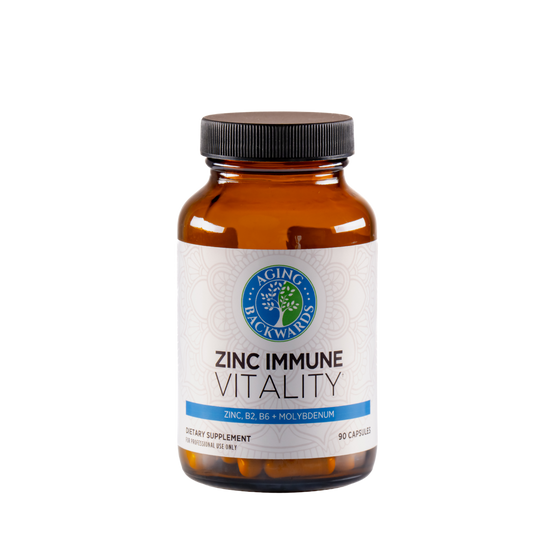
The riboflavin, B6 (as P5P, the active form), and molybdenum in the capsule help zinc do its work. Zinc is the lead.
How to get the most out of it
Take a real dose, in a form that absorbs. One capsule is 30 mg of zinc bisglycinate, which was 43% more bioavailable than zinc gluconate in a crossover study [7]. That's three to four times the RDA and under the 40 mg daily upper limit [8].
Why 30 mg, not 50. The animal data point to a sweet spot: extra zinc helped in the multiple sclerosis model, and so did keeping free zinc in check with a weak chelator [9]. So 30 mg is the amount that fills the gap without crowding out copper — a dose your doctor can build on, where most 50 mg store capsules overshoot.
Take it with food, and give it space. A meal prevents the nausea zinc can cause. Iron of 25 mg or more, high-dose calcium, and quinolone or tetracycline antibiotics compete with zinc — separate them by two hours [8].
Give it time. The infection trial ran twelve months, not twelve days. This is a foundation, not a rescue.
At a glance: how much to take
The label is your starting point, not your ceiling. The trials behind this product often used more, and the rows below show where the research went. Anything above the label is a conversation to have with your own physician — bring the numbers with you.
| Situation | How much | Notes |
|---|---|---|
| Start here (label) | 1 capsule daily with a meal, away from iron or calcium | Three months, then zinc/copper labs to continue |
| Doctor-guided higher range | 45 mg a day — the dose the year-long infection trial used [6] | Above the 40 mg general limit, so only with your physician watching zinc and copper every 3 months |
| During a cold | Stay at your usual dose | Count every zinc source (lozenges, multis) |
| Ask first | — | New numbness or unsteadiness (check copper first); bariatric surgery or celiac history |
| Multiple sclerosis relapse or new symptoms | Don't change any dose on your own | Call your neurologist first |
If this is you
You catch everything, and it lingers. Take one capsule daily with a meal. Commit to three months before you judge it. Eat copper-rich foods alongside (nuts, seeds, shellfish, dark chocolate). To continue past three months, ask your doctor for serum zinc, copper, ceruloplasmin, and a CBC. What you want to see: zinc in the upper half of the lab's range — the healthy controls in the multiple sclerosis study averaged about 95 µg/dL (14.6 µmol/L) [4] — with copper still comfortably in range. Zinc rising while copper falls is the pattern to catch early.
You already take a multivitamin, lozenges, or anything else with zinc. Do the arithmetic — lozenges and even denture cream count. Stay under 40 mg a day total unless your doctor is watching labs. If you're already near 40, don't add this one.
You notice new numbness or unsteady walking while on zinc. Don't assume it's multiple sclerosis. Ask for a copper level first, and pause the zinc until you have an answer.
A word on copper, because this is how you do zinc right. At high doses over months, zinc switches on a gut protein that traps copper [8]; copper deficiency causes numbness, unsteady walking, and spinal-cord MRI changes that look a lot like multiple sclerosis [10, 11]. At 30 mg you're inside the safe range; the problem cases took 50 mg or more for a long time [8]. Prior bariatric surgery or celiac disease raises the risk, so monitor more closely; some people on long-term zinc add 1–2 mg of copper — a conversation for you and your clinician. Zinc has no documented interaction with any disease-modifying therapy, which is reassuring — and tell your neurologist anyway, since people on DMTs ran lower in the zinc study [4] and it's a useful thing for them to know. In pregnancy and nursing the 40 mg limit still applies, but check with your obstetric provider.
Whichever route you've chosen for the disease itself. Some in our community take a disease-modifying therapy; some, with their doctors, have chosen not to. The dose is the same either way. On a DMT, note that people on treatment ran lower on zinc in the multiple sclerosis study — one more reason to take it. Off a DMT, there's nothing to interact with; the three-month labs and the copper rule apply just the same.
Where Tami landed
"I used to dread cold season because I knew what it would cost me. These days a bug is mostly just a bug — I'm tired for a few days, and then I'm back on the court. Zinc is one of the dependable ones. It just does its job, every day."
That's my read of the research too. If your pattern is "I catch everything and it lingers," the biology, the human data, and our own house all point the same way — take it with food, keep the dose sane, and keep copper in the picture.
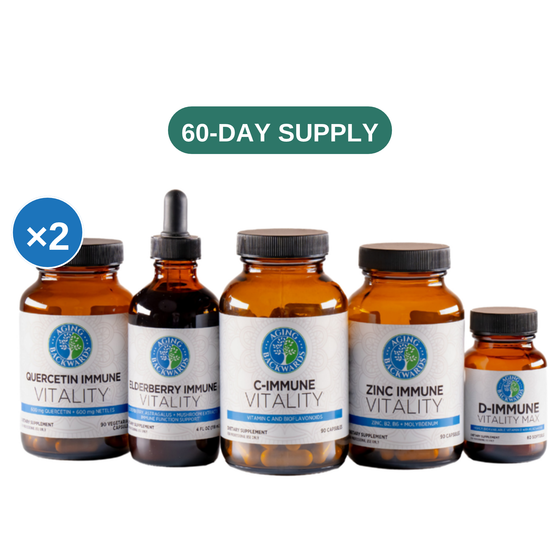
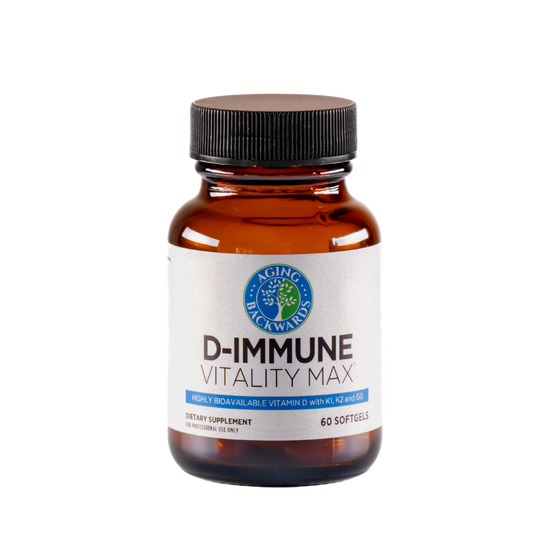
Zinc Immune Vitality™ is part of the Immune Vitality Max Package™ at agingbackwardswellness.com. If every passing bug costs you a week, this is a sensible place to start.
References
- Prasad AS. Zinc in human health: effect of zinc on immune cells. Mol Med. 2008;14(5–6):353–357. PMID 18385818. https://doi.org/10.2119/2008-00033.Prasad
- Rosenkranz E, Maywald M, Hilgers RD, et al. Induction of regulatory T cells in Th1-/Th17-driven experimental autoimmune encephalomyelitis by zinc administration. J Nutr Biochem. 2016;29:116–123. PMID 26895672. https://pubmed.ncbi.nlm.nih.gov/26895672/
- Bredholt M, Frederiksen JL. Zinc in multiple sclerosis: a systematic review and meta-analysis. ASN Neuro. 2016;8(3):1759091416651511. PMID 27282383. https://doi.org/10.1177/1759091416651511
- Pawlitzki M, Uebelhör J, Sweeney-Reed CM, et al. Lower serum zinc levels in patients with multiple sclerosis compared to healthy controls. Nutrients. 2018;10(8):967. PMID 30049983. https://doi.org/10.3390/nu10080967
- Science M, Johnstone J, Roth DE, Guyatt G, Loeb M. Zinc for the treatment of the common cold: a systematic review and meta-analysis of randomized controlled trials. CMAJ. 2012;184(10):E551–E561. https://doi.org/10.1503/cmaj.111990
- Prasad AS, Beck FW, Bao B, et al. Zinc supplementation decreases incidence of infections in the elderly: effect of zinc on generation of cytokines and oxidative stress. Am J Clin Nutr. 2007;85(3):837–844. PMID 17344507. https://pubmed.ncbi.nlm.nih.gov/17344507/
- Gandia P, Bour D, Maurette JM, et al. A bioavailability study comparing two oral formulations containing zinc (Zn bis-glycinate vs. Zn gluconate) after a single administration to twelve healthy female volunteers. Int J Vitam Nutr Res. 2007;77(4):243–248. PMID 18271278. https://doi.org/10.1024/0300-9831.77.4.243
- National Institutes of Health, Office of Dietary Supplements. Zinc — Fact Sheet for Health Professionals. https://ods.od.nih.gov/factsheets/Zinc-HealthProfessional/
- Choi BY, Jeong JH, Eom JW, et al. A novel zinc chelator, 1H10, ameliorates experimental autoimmune encephalomyelitis by modulating zinc toxicity and AMPK activation. Int J Mol Sci. 2020;21(9):3375. PMID 32397660. https://doi.org/10.3390/ijms21093375
- Kumar N, Gross JB Jr, Ahlskog JE. Copper deficiency myelopathy produces a clinical picture like subacute combined degeneration. Neurology. 2004;63(1):33–39. PMID 15249607. https://doi.org/10.1212/01.wnl.0000132644.52613.fa
- Rowin J, Lewis SL. Copper deficiency myeloneuropathy and pancytopenia secondary to overuse of zinc supplementation. J Neurol Neurosurg Psychiatry. 2005;76(5):750–751. PMID 15834043. https://doi.org/10.1136/jnnp.2004.046987
These statements have not been evaluated by the Food and Drug Administration. This product is not intended to diagnose, treat, cure, or prevent any disease. This article is educational and reflects published research; it is not medical advice and does not create a doctor–patient relationship. Multiple sclerosis is a serious condition — please discuss any supplement with your neurologist or physician, especially if you take a disease-modifying therapy or other prescription medications.
Aging Backwards Wellness · Manti, Utah · agingbackwardswellness.com